
Turn results into interactive UI
Generative UI lets an agent render a useful result as a table, comparison, timeline, small dashboard, review surface, or bounded control inside the conversation. The UI stays attached to the request and reasoning that produced it.
Use an interface when structure matters
Section titled “Use an interface when structure matters”Use generative UI when seeing structure or acting on a bounded result is clearer than reading paragraphs: comparing candidates, reviewing metrics, choosing an option, or inspecting a compact status view. Keep simple answers as text and use a durable artifact for large documents or full applications.
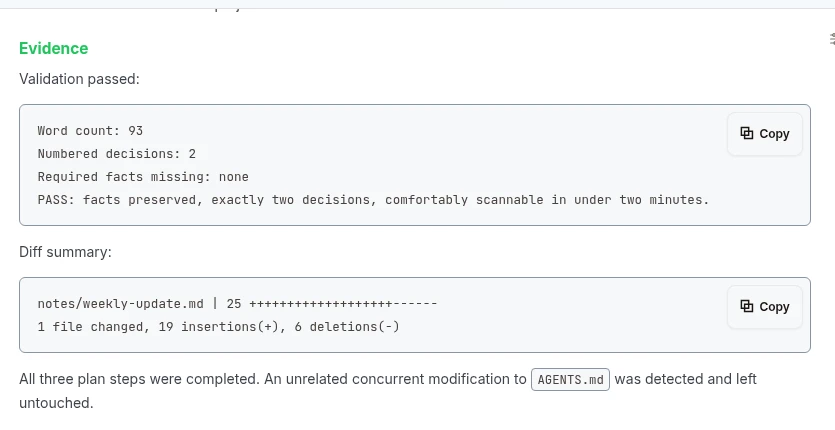
The page is the generated outcome itself. It is not evidence that every answer should become a custom application.
What the right surface changes
Section titled “What the right surface changes”- Faster comprehension. Structure, hierarchy, and state become immediately visible.
- Decisions in context. Review controls stay beside the evidence and reasoning.
- Progressive detail. Compact summaries can reveal records or evidence only when needed.
Mission: render one useful interface
Section titled “Mission: render one useful interface”- Choose a result whose structure is hard to scan as prose.
- Pick the smallest fitting surface: table, cards, timeline, chart, or bounded interaction.
- Keep the human-readable answer and provenance available around the interface.
- Test the surface in narrow mobile and wider desktop layouts.
- Confirm actions are explicit, safe, and persisted when the interface is durable.
Keep interaction proportional to the result
Section titled “Keep interaction proportional to the result”Generative UI is a presentation and interaction surface, not permission to perform an external write. Consequential actions still need the appropriate approval gate. Do not turn a concise answer into decorative UI, hide essential context behind an interaction, or use a small inline block for a large review that needs a durable artifact.
Related references
Section titled “Related references”Put this to work: Run a mission and ask for the smallest interface that makes the result clearer.