
Turn one goal into a coordinated team
Sub-agents let one parent session delegate genuinely independent work without losing the root goal. Each child has a narrow outcome; the parent owns coordination, integration, and final proof.
Split only work that can move independently
Section titled “Split only work that can move independently”Use sub-agents when two or more slices can progress independently—for example research across separate sources, implementation in disjoint systems, or implementation plus an independent review. Keep sequential work in one session.
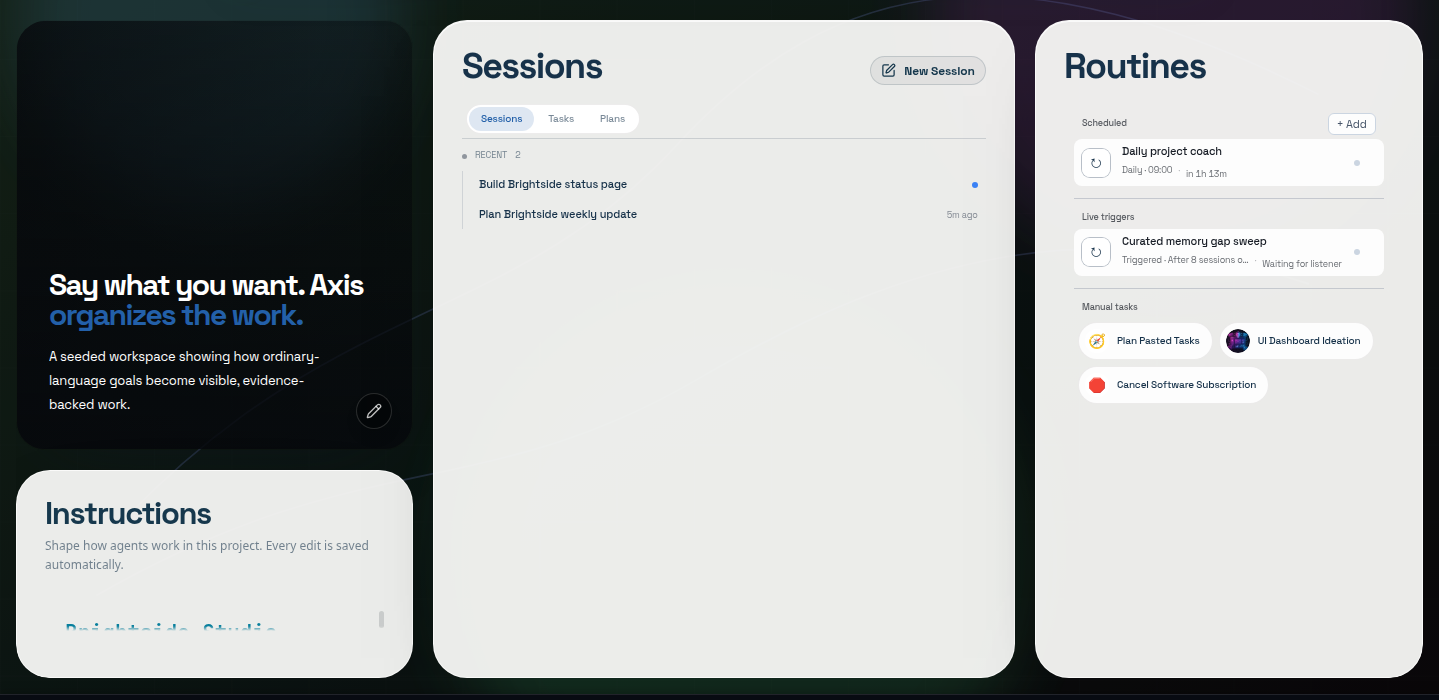
Direct proof: Open the Agent Graph after spawning. Every queued or active child should appear beneath its launch parent, remain individually inspectable, and lead back to one root orchestration.
What coordinated delegation adds
Section titled “What coordinated delegation adds”- Parallel progress. Independent slices move without waiting on one another.
- Visible ownership. The graph keeps parent, child, model, and status connected.
- One outcome. The parent reconciles evidence instead of returning disconnected answers.
Mission: delegate a bounded workstream
Section titled “Mission: delegate a bounded workstream”- Define the shared objective and acceptance criteria.
- Split only disjoint slices with explicit file or system ownership.
- Give each child the needed context, boundary, deliverable, and proof standard.
- Track queued and active children from the parent and Agent Graph.
- Integrate the results and validate the whole outcome from the parent.
More agents are not automatically faster
Section titled “More agents are not automatically faster”More agents do not make a sequential task parallel. Children editing the same files or external records create conflict rather than speed. A completed child does not prove the parent goal is complete, and product, cost, risk, or business decisions still return to the human as one coherent choice.
Related references
Section titled “Related references”Put this to work: Structure the shared Plan before you split its independent leaves.