
Concept boundary
Standing rules
Put project-wide operating expectations in AGENTS.md.
It is
- Safety boundaries
- Validation standards
It is not
- One task’s outcome
Your project’s AGENTS.md is its working agreement. It tells every agent how to operate
before the specific request arrives: the mission, boundaries, validation standard,
important workflows, and rules that must survive from one session to the next.
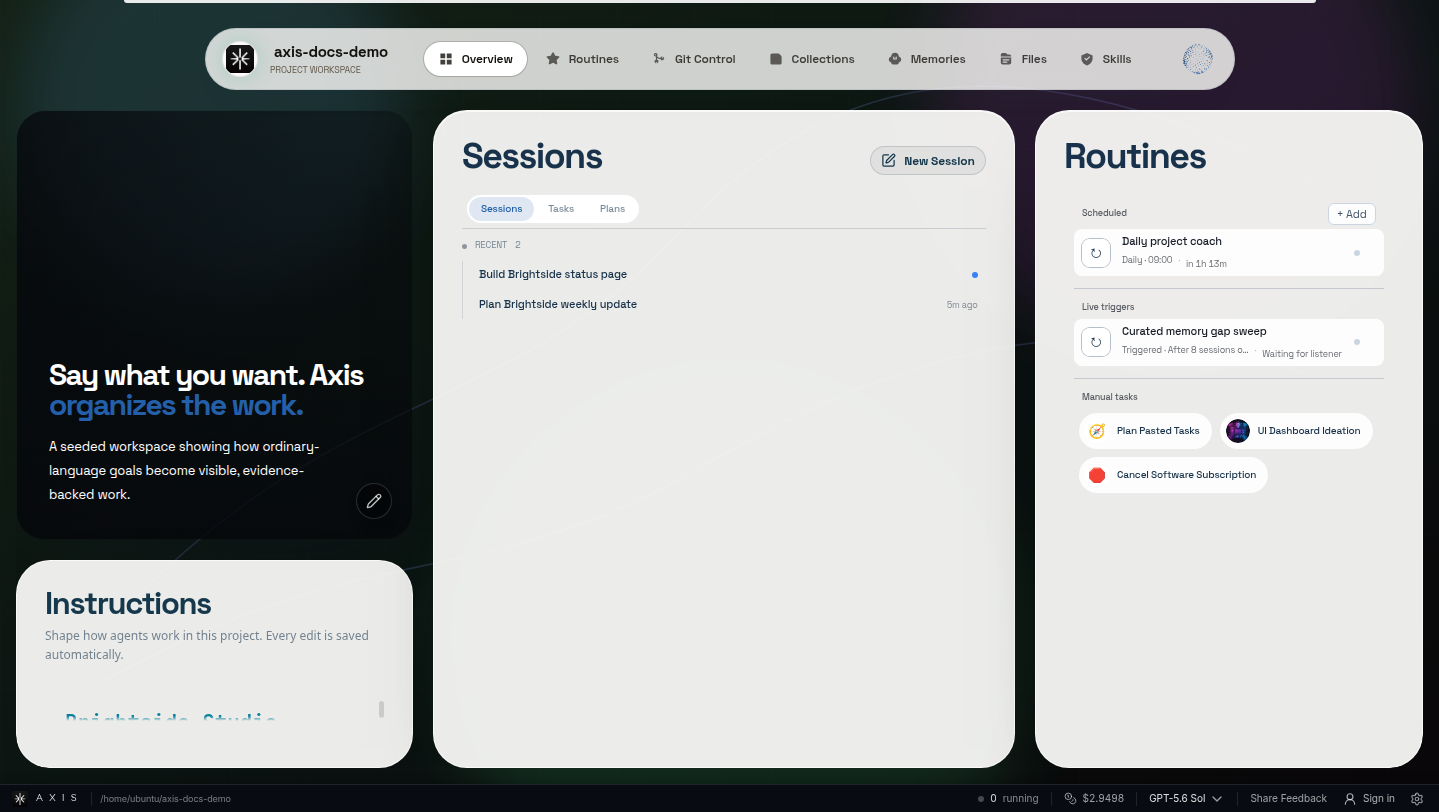
Plain language, privacy boundaries, approval rules, and evidence standards live in one durable place.
Business and technical work both inherited the same agreement automatically.
Scheduled work does not bypass the project’s safety or proof standards.
Without a working agreement, every session begins with a policy interview. You repeat which tests matter, what must never be deployed automatically, which terminology is canonical, and where authoritative state lives.
Put stable operating rules in one place and keep task-specific requests in the session.
A useful rule explains both what and why:
## Visual changesOpen the real route and inspect a post-change screenshot before claiming success.A passing DOM assertion does not prove the interface looks right.Concept atlas
Concept boundary
Put project-wide operating expectations in AGENTS.md.
Concept boundary
Put reusable corrections, preferences, and reasons in Memory.
Concept boundary
Put active, open, and deferred work in a shared work plan.
Concept boundary
Keep authoritative architecture and behavior in project source and documentation.
Concept boundary
Use the session request for the result you want now.
Start small:
A short agreement that agents can follow beats a large policy archive nobody can scan. When a rule grows into a long operating guide, keep the concise rule and link to the detail.
With the agreement in place, you can say:
Add the same approval boundary to the export workflow and prove the real state.The request carries the outcome. The project supplies the established safety and proof standard. If the relevant rule is missing or ambiguous, the agent should investigate and ask only when the decision materially belongs to you.
Treat AGENTS.md as living project documentation. Update it when a correction should guide every future agent. Remove stale rules when the source of truth changes. Do not let a one-off task silently rewrite the agreement without reviewing the broader effect.
Start a fresh low-risk session and give it an ordinary request. It should discover and follow the relevant rule without you pasting the rule again. Inspect the evidence, then refine the agreement if the behavior was ambiguous.