
Work plans
A work plan is project-scoped intent that multiple sessions can continue. It prevents each agent from inventing a private checklist, repeating completed work, or dropping a future item into prose nobody revisits.
Proof sequence
Intent becomes verifiable work
The same Brightside mission shows the plan before, during, and after execution.
Outcome first
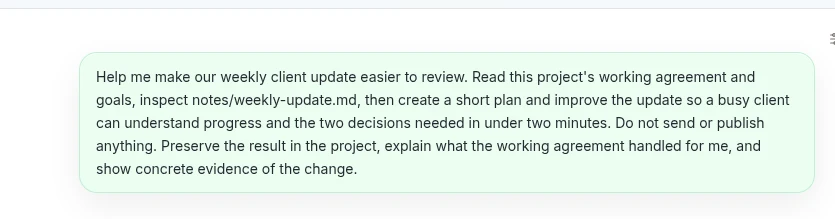
The request defines the result and the safety boundary. Plan stays visible
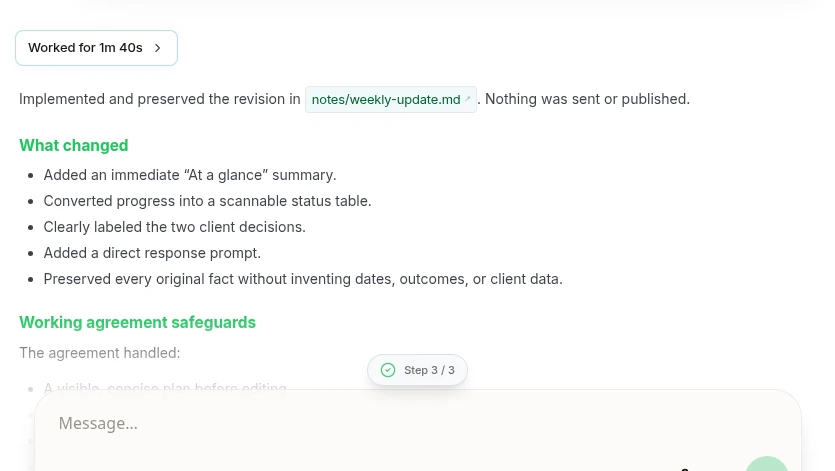
The session retains the plan state while explaining the completed work. Completion points to evidence
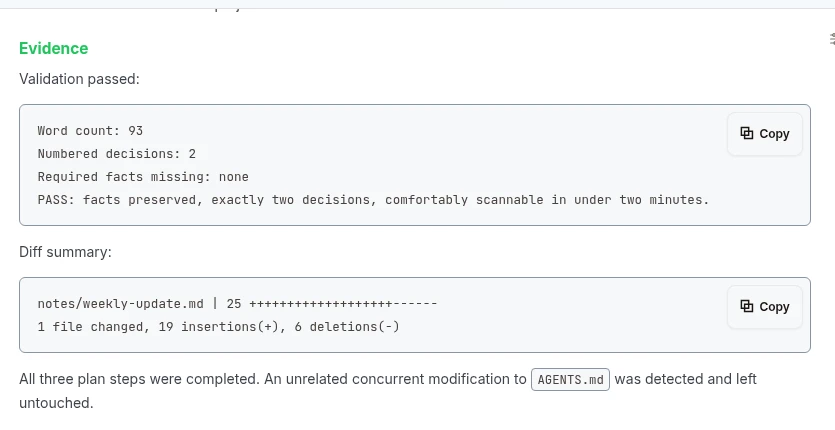
Completed steps resolve to proof, not only checked boxes.
Begin by finding existing intent
Section titled “Begin by finding existing intent”Before adding its first item, an agent checks whether a related plan already exists. Matching can use the goal, linked work, contributing sessions, and project context. Continue the real match; create a new plan only when the objective is genuinely new.
That recall step is what makes plans shared rather than a pile of duplicate lists.
Structure work around verifiable leaves
Section titled “Structure work around verifiable leaves”Large work should use phases with concrete child items. A useful leaf names one action that can be completed and proved. Plans may include discovery, implementation, integration, validation, and closeout rather than one vague “build feature” row.
The active session can show a compact step indicator above the composer. The full plan remains a project surface, not transcript narration.
Defer instead of dropping
Section titled “Defer instead of dropping”If work is real but out of scope now, defer it with:
- an optional date when it should resurface,
- a note explaining the context and next useful action.
Deferred work stays recorded but does not pretend to be immediately actionable. Backlog views can surface due, blocked, stale, or forgotten work later.
Coordinate contributors safely
Section titled “Coordinate contributors safely”Plan items can show who is actively working and what evidence completed them. Claims help prevent two sessions from silently taking the same leaf; they do not replace clear file or system ownership in parallel work.
Removal should be recoverable. Clearing one session’s local view must not destroy shared work contributed by another session.
Complete with evidence
Section titled “Complete with evidence”A checked box is not enough for meaningful work. Completion should point to the changed state, test, output, destination, or session that proves the item was finished.
A parent phase completes only when its required children and integration checks are complete.
Concept boundary
Section titled “Concept boundary”- Plan: current shared intent.
- Task: work waiting to begin or be resumed.
- Memory: learned knowledge.
- Routine: repeatable work that can run again.
- Session: the continuing thread that performs and records the work.
Mission complete when
Section titled “Mission complete when”A fresh session can find the existing objective, identify the next unblocked leaf, see what was deliberately deferred, and avoid redoing completed work.