
How to work with Axis
You do not need to supervise every tool call or learn a special prompt dialect. Your job is to set direction, correct meaning, judge trade-offs, and inspect proof.
Proof sequence
Ask, judge, inspect
The user supplies direction and judgment; the harness carries the coordination.
1 · Ask normally
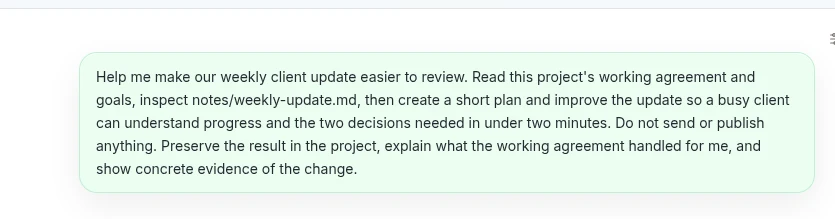
State the outcome, source, and meaningful boundary—not a technical recipe. 2 · Review the result
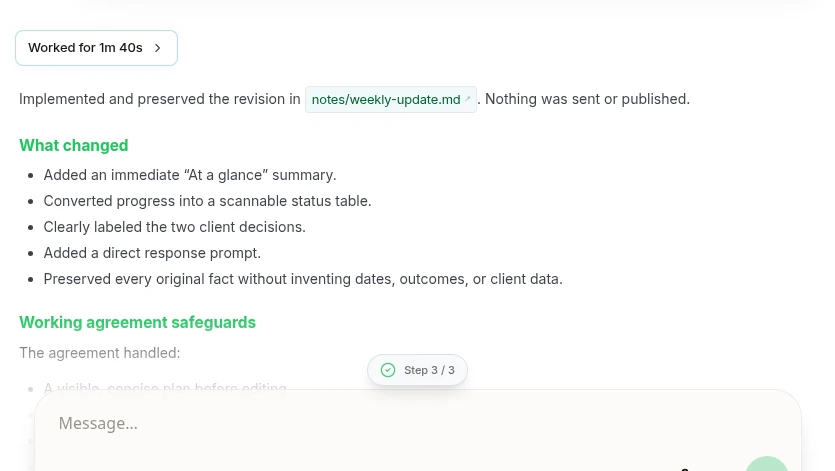
The agent explains what changed and what the working agreement handled. 3 · Inspect proof
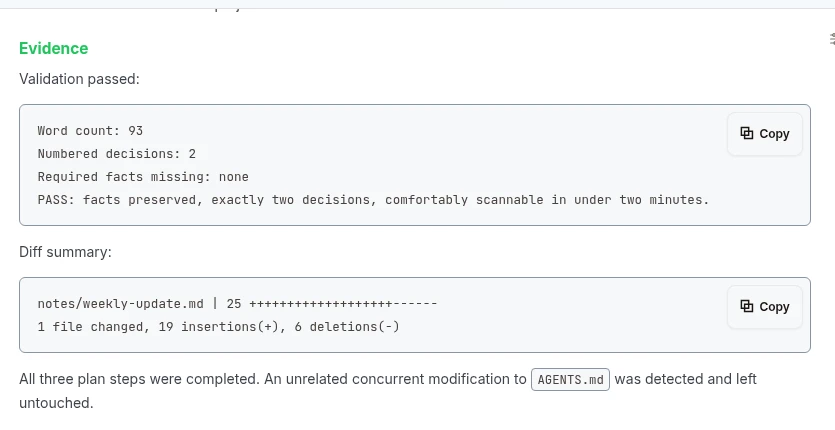
Evidence answers the claim without making you read every tool call.
1. Name the outcome in ordinary language
Section titled “1. Name the outcome in ordinary language”Start with the problem and what a good result would change:
Customers are abandoning this form on mobile. Find the friction, improve the realflow, and show me the before/after experience and any trade-offs I should judge.You do not need file paths or implementation instructions unless they are genuinely part of your intent. Axis should use the project working agreement, source, memory, and tools to discover reversible details.
2. Let the harness carry context
Section titled “2. Let the harness carry context”Before asking a long questionnaire, an agent should inspect what is already available: project rules, relevant memory, files, active work, connected systems, and current state. It should infer safe reversible defaults and bring you only decisions that materially change scope, cost, risk, architecture, or experience.
If you keep restating the same rule, move it to the working agreement or Memory instead of making prompts longer.
3. Use one session for one coherent thread
Section titled “3. Use one session for one coherent thread”A session should have a recognizable outcome. Continue it while the work and evidence belong together. Start a separate session when the objective genuinely changes.
Use /btw for a tangent that deserves its own child thread without derailing the main
work. Use sub-agents only when slices are independent and the parent can integrate them.
4. Intervene at the level of meaning
Section titled “4. Intervene at the level of meaning”If the work is headed toward the wrong customer, trade-off, or boundary, correct it early. A follow-up during active work enters the steering queue.
Do not micromanage reversible implementation details the agent can discover. Do step in when:
- the goal was misunderstood,
- a risky action is about to cross its approved scope,
- a product or business trade-off requires your judgment,
- the evidence standard is wrong for the claim.
5. Read evidence selectively
Section titled “5. Read evidence selectively”The Working fold lets you inspect chronology without forcing every command into the main transcript. Open the actions that matter. For completion, inspect the authoritative surface: the real route, test, destination, saved output, or persisted state.
“Done” is navigation to proof, not proof itself.
6. Treat approvals as designed checkpoints
Section titled “6. Treat approvals as designed checkpoints”An approval should state why it is needed, what is at stake, the exact action being authorized, and what remains untouched. Approve only that scope. Deny or revise when the evidence or trade-off is not good enough.
7. Close the learning loop
Section titled “7. Close the learning loop”At the end of meaningful work:
- Put durable operating rules in AGENTS.md.
- Put learned knowledge in Memory.
- Put unfinished intent in the shared work plan.
- Keep durable results in Collections.
- Leave transient command output in the session unless it proves something important.
8. Turn genuine repetition into a Routine
Section titled “8. Turn genuine repetition into a Routine”When the same outcome, inputs, and judgment boundary repeat, create a Routine. Do not automate a process whose prompt changes every run or whose central decision still needs you each time.